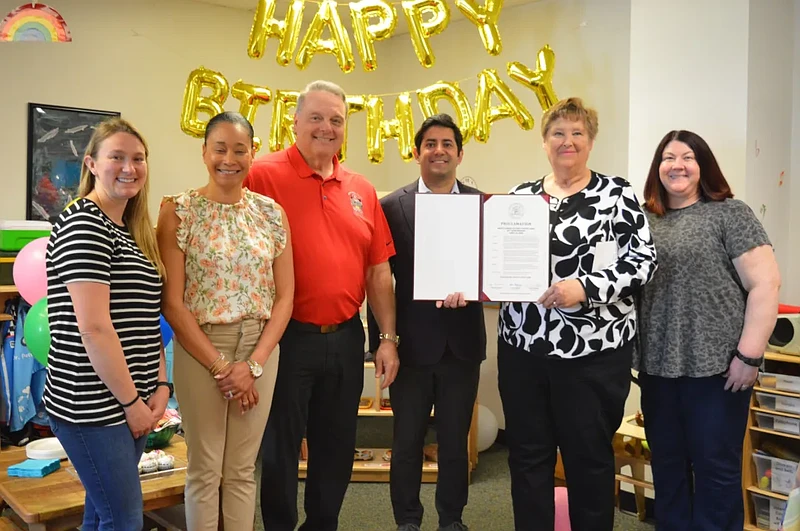
Officials gather for a photo on April 15, 2026 to present a proclamation to commemorate 30 years of Montgomery County Court Care services. Pictured, from left is Court Care Teacher Brittany Hutt, Montgomery County Commissioners’ Chairwoman Jamila Winder, Commissioner Tom DiBello, Vice Chairman Neil Makhija, Court Care Director Linda Awarski and Court Care Teacher Anne Martin. (Rachel Ravina – MediaNews Group)
On the sixth floor of an office building in Norristown is a place of refuge for children whose parents need to spend time in the Montgomery County Courthouse.
The rooms inside Montgomery County Court Care feature colorful murals, artwork, balloons, plenty of toys for children to play with, and of course, Director Linda Awarski.
“Our families come here simply because of the fact that they are doing everything they can to protect their children. They love their children, and they don’t know what else to do,” Awarski, who has led the operation since its inception in 1996, said in an interview.
Montgomery County Commissioners gathered on Wednesday inside the child care center, on the sixth floor of One Montgomery Plaza, 425 Swede St., to present a proclamation and an $11,750 check to commemorate the center’s 30th anniversary and honor the ongoing efforts of Awarski and her three staff members who care for up to a dozen children on a given day.
“This is amazing. This is a really nice surprise,” Awarski said of the mid-week festivities that occurred during the Week of the Young Child.
Commissioners pay visit
For Montgomery County Commissioners’ Chairwoman Jamila Winder, taking a moment to observe the annual celebration from April 11 to April 17 was an opportunity to show how “this program is quite unique” to offer assistance for parents “while they’re taking care of their business” at the nearby courthouse.
Montgomery County Commissioners’ Vice Chairman Neil Makhija agreed.
“Being a parent is hard enough, navigating government is hard enough, and having to do both is even harder,” Makhija said. “So this is a place where at a challenging time, you can trust that we have amazing employees who’ve worked here for decades taking care of kids.”
Officials noted the funds from federal COVID-19 relief dollars could procure resources for the free, licensed drop-in child care center.
“This is a great service that is part of the county that a lot of people just don’t know exists,” said Montgomery County Commissioner Tom DiBello.
The Keystone STAR 4 child care center aims to support jurors, individuals involved with the criminal justice center and their families. But for Awarski, it’s much more than that. It’s a place of structure for children ranging in age from 6 weeks to 12 years old.
“We’re doing nap times and snack times and book times and circle time and art time and gross motor play, and we do that for every single age and they get into a routine,” she said. “Our biggest problem is they don’t want to leave.”
Establishing accessible child care
Awarski brings a sense of passion and dedication to her work over the last 30 years at Montgomery County Court Care.
“I’m going to be 67 years old and I’m still here,” Awarski said.
Awarski, an educator with a tenure spanning nearly 50 years, began her work with the county in the subsidized day care office. Awarski recalled a pressing need for child care in close proximity to justice centers.
“We were looking at what was happening in Washington, D.C. with jurors,” she said. “We were seeing that jury panels were not being significantly shared by women of childbearing years because they had no one to care for their children.”
Noticing a gap that needed to be filled, county officials back in the 1990s sought to launch an program that could find a local solution to a growing problem. The goal, Awarski stressed, was to cultivate a resource for women called for jury duty to bring their children.
She noted “a place where women could breast feed their child, [and] a place they could visit their child through the course of a seven-eight-hour day” was crucial. It became the “first licensed walk-in, drop off child care for courts” in Pennsylvania.
“If I go back to the early days, we were serving a huge population of domestic relations. That population has changed,” Awarski said.
Common clientele includes individuals involved with jury selection, criminal charges, as well as a “a massive custody of PFA caseload,” also known as “protection from abuse service,” according to Awarski.
Community outreach remains at the foundation of Montgomery County Court Care, Awarski maintained, and “our primary goal at that point is to find out what their needs are.” Awarski conducts a “needs assessment” on each parent and child who visits the center to get a better sense of how her staff can assist.
“Do you need food? Do you need shelter? Do you need clothing? Are you in a situation where you’re not free to talk about anything to anyone or discuss things? Have any of your children been physically or sexually abused? Most times, the answer to that –70 percent of the time– is yes,” she said.
“It’s very emotional – because it is,” Awarski said. “They’re coming at the worst time in their life, and we of course feel very indebted to do whatever we can for that moment.”
Asking for help
Awarski noted how an interaction with Montgomery County Court Care could be the first time a parent might disclose the details of their particular situation and reach out for help. Awarski stressed how important it is that they foster that sense of trust.
“I’m not the expert in all those fields, but I do know people that are,” Awarski said. “So we’re going to make sure that we can give them resources and guidance to help them change their life.”
Awarski and her staff might care for children for a time, but the experience leaves a lasting impact. In some cases, they return to the facility as adults.
“We actually call them ‘alumni’ because we’ve had families that we have known for 30 years and watched them grow,” she said. “But the nice side of the coin is we have families that [come] in where I always say, ‘all I’m doing is putting a fingerprint on you.’”
“I can’t change your world, but one fingerprint might be the difference today. That’s what you needed today. Maybe I helped you in a way,” she continued.
A Montgomery County spokesperson estimated some 2,800 people are served each year, with more than 300,000 since 1996.
“But I’ll tell you right now, today’s proof it pays off,” Awarski said.