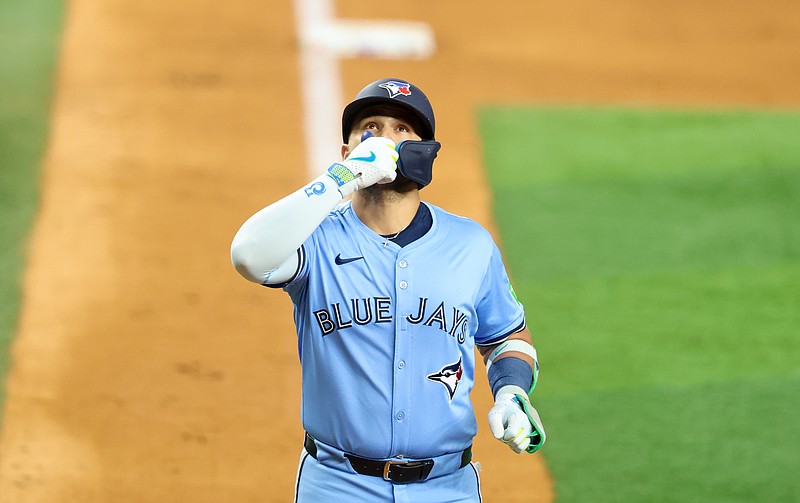
May 28, 2025; Arlington, Texas, USA; Toronto Blue Jays shortstop Bo Bichette (11) reacts after hitting a two-run home run during the ninth inning against the Texas Rangers at Globe Life Field. Mandatory Credit: Kevin Jairaj-Imagn Images Kevin Jairaj
Phillies president of baseball operations Dave Dombrowski addressed the elephant in the room Tuesday during a Zoom session — the organization's view on player opt-out clauses.
Earlier this offseason, general manager Preston Mattingly revealed during an interview that the Phillies are up front with potential free agents that they don't include opt-out clauses in contracts.
That became particularly relevant information last Friday when Bo Bichette turned down a reported seven-year/$200 million contract from the Phillies to instead take a three-year/$126 million deal with the New York Mets that gives him the opportunity to opt out and return to free agency after 2026 and 2027.
Dombrowski revealed Tuesday that Bichette's camp was aware from the outset of their conversations that the Phillies weren't interested in doing a short-term deal with opt outs. But given that Bichette, Kyle Tucker, Alex Bregman and Cody Bellinger have all signed these type of deals in recent years, are the Phillies now at a point where they need to reconsider their stance on opt outs?
"Well, we have not given opt outs, and a lot of clubs don't give opt outs," Dombrowski said. "We're not the only ones that don't do it. I guess you never say anything's in concrete, but you have to be careful, because you can give long-term, big contracts, and then you can give opt outs. You still have to realize where you are as an organization from a financial perspective.
"I have never felt myself — and still don't feel — that it's a wise move to make when you look at the risks that are attached to it. Because the reality is if a player has a bad year, they opt in, and if they get hurt, they opt in. So double the amount that you're paying a player for one year, and that becomes two years."
Dombrowski continued in his answer on the pros and cons — mostly cons — of including player opt outs in a contract.
"And can you afford to do that? And, of course, we're also involved when it comes down to taxation. I know other organizations are too, but if they opt out, it's generally because they've had a good year then," Dombrowski said.
"So that has not changed for years. You always are open minded to doing things that you think are the best, but it's generally not a philosophy that I have liked, that we have liked. Will you be open minded? I guess you're always open minded to anything."
The Phillies actually did include an opt-out clause in the contract that they gave Jake Arrieta in March of 2018, but it wasn't a true opt out. The former NL Cy Young Award winner could exercise an opt out clause following the second season of a three-year/$75 million contract. However, the Phillies could void his chance to go back to free agency by guaranteeing additional years on the contract. Obviously, Arrieta's time with the Phillies went poorly enough that it didn't matter, but that is an example of the organization dipping their toes into doing opt outs.
Granted, that contract was signed under former general manager Matt Klentak, and predated Dombrowski's arrival to the organization. That makes you wonder whether Dombrowski isn't willing to include opt outs because that's the organizational policy, or if the Phillies have taken on that policy because their top baseball executive had it prior to arriving.
"It's a policy that I've had for a long time," Dombrowski said. "And I think, I would say the majority of clubs have that policy."
There is a strong argument to be made for not being willing to include opt outs on these type of short-term contracts.
The Boston Red Sox signed Alex Bregman to a three-year/$120 million contract last winter, a pact that included opt outs after the first and second seasons. Additionally, they gave up their second and fifth-round picks in the 2025 MLB Draft — along with $1 million in international bonus pool money — because Bregman had turned down a qualifying offer from the Houston Astros.
Bregman was an All-Star for the Red Sox in 2025, but after just 114 regular-season games and an ALWCS playoff exit, he opted out of his deal. Bregman left this offseason to sign in free agency with the Chicago Cubs. Boston — who greatly limited their ability to draft and sign amateur talent this past year by signing a qualified free agent — was left empty-handed. The Mets could face the same situation with Bichette next winter, and if they don't, it's because he didn't have a good 2026 season.
If Bichette — who will be 28 years old on Opening Day — had been willing to take the seven-year/$200 million deal from the Phillies, they would have parted with the draft picks and international bonus pool money without thinking twice. But doing it for only one guaranteed season isn't good business.
At the same time, if Dombrowski and the Phillies are prepared to stand on business with this policy, it will cost them some free agents. That may be the right move for the long-term health of the franchise, but it doesn't make missing out on Bichette in the short term — particularly when he landed with their top rival — burn any less.
The compromise here might be this. If Bryce Harper (13 years/$330 million) had listened to Scott Boras and insisted on an opt-out clause in his contract — let's say, after the fifth season — it would have been dumb to lose him over that. But if the Phillies don't want to give opt outs after a year and/or two of a massive contract, it's hard to fault them.