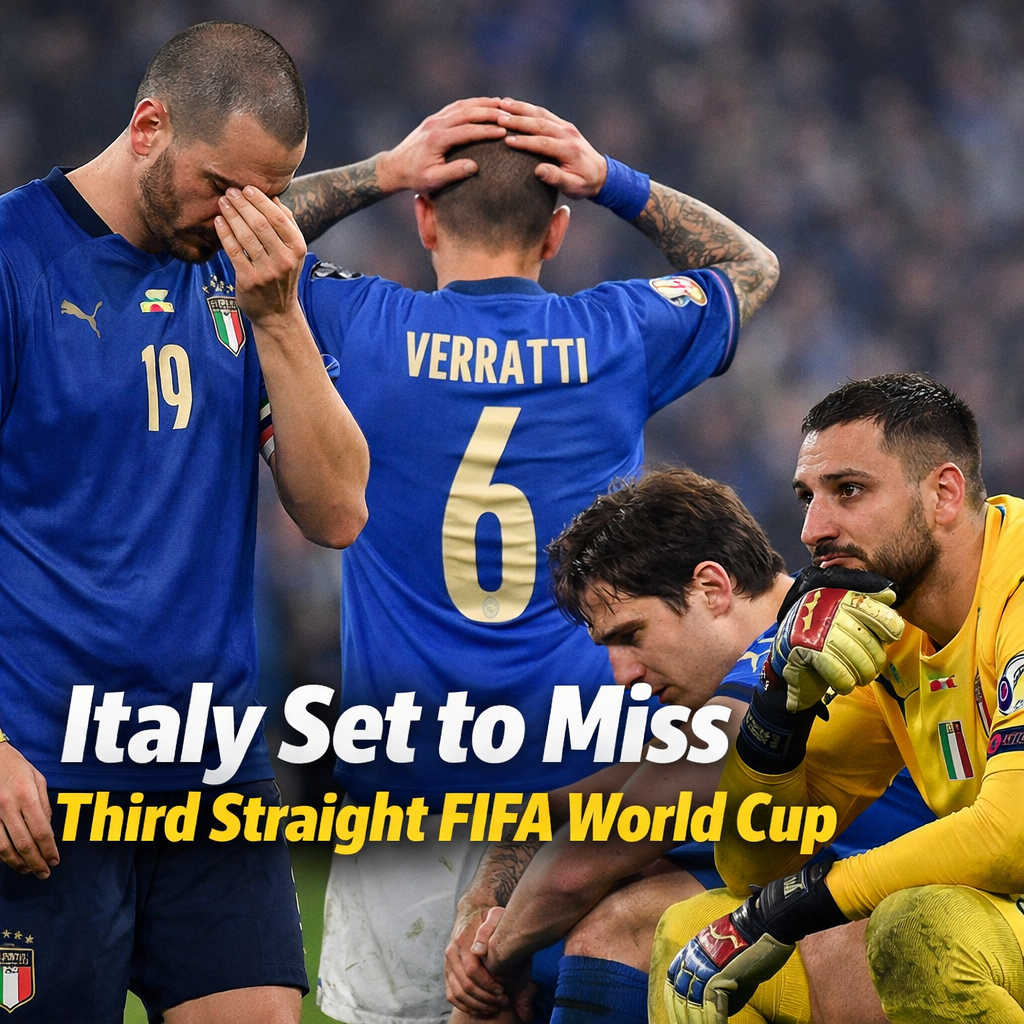
The Italian soccer team, renowned as “Gli Azzurri”, will miss their third straight FIFA World Cup, starting from June 2026 in the U.S, Canada, and Mexico.
As a die-hard soccer fan who’s been following the sport for decades, it hurts to see the Italian soccer team's downfall. The same national team lifted this prestigious trophy two decades ago, and now, they’ve failed to qualify for the third time in a row.
Honestly, it would’ve been a delight to watch this Italian side compete at the biggest stage, but the defeat against the underdog, Bosnia, sealed their exit from the qualifying round.
I still remember how some of the greatest line-ups the world has ever seen trembled against the likes of Buffon, Pirlo, and Maldini. But that’s not the case anymore, and in this article, I will analyze some reasons that contributed to the decline of the Italian soccer team over the last several years.
So, let’s get started.
A few days ago, I upgraded to one of the fastest yet affordable Xfinity Internet plans so that I could stream the European qualifiers without any hassle. While Sweden vs. Poland, Czechia vs. Denmark, or Turkiye vs. Kosovo didn’t disappoint, it was Italy vs. Bosnia that lacked intensity and attacking soccer.
Italy vs. Bosnia was the most boring fixture of the European qualifiers. Even though Italy seemed a much better and more balanced side than Bosnia on paper, they couldn’t even move the ball around with ease.
This lack of initiative to pass the ball around and create counter-attack opportunities becomes more visible against the top-quality sides. And Bosnia not only exploit this weakness, their attackers relentlessly targeted Italy’s defenders to build and keep the pressure.
Serie A, which once produced the European Champions, has been in decline for the last several years. One of the most successful Italian teams, Juventus, has failed to qualify for the UEFA Champions League several times.
Also, apart from Moise Kean and a few other players, the Italian domestic league has failed miserably to produce quality names. This decline of Serie A has directly impacted the national team’s quality and made them more vulnerable against the top international sides.
On the other hand, we’ve seen how La Liga, specifically Barcelona, Real Madrid, and Atletico Madrid, actively contribute from the Spanish side. Besides their youth academies, such clubs train domestic players for the international side.
Carlo Ancelotti, one of the finest managers ever to embrace this game, is leading Brazil. Lionel Scaloni is managing Argentina, and Spain will start their World Cup campaign under Luis Enrique. Julian Nagelsmann, who won the Bundesliga with Bayern Munich, is in charge of the German football team.
These managers have proved their mettle in some of the best European domestic leagues and earned their place. They’ve experimented with different formations and tactics in domestic leagues and then made their way to the bigger stages.
On the other hand, Italy’s manager and their former superstar, Gennaro Gattuso, has only managed a handful of teams, notably Valencia and AC Milan. With little international exposure, Gattuso fails to adapt his tactics. And, in my opinion, most teams have already figured out ways to outsmart his playing style.
In addition, Gattuso’s lack of technical knowledge has severely impacted the Italian side. They’ve failed to upgrade their gameplay over time and lost some crucial fixtures.
From Luca Toni leading the charge to Pirlo holding the midfield, and Cannavaro stabilizing the defense, to Buffon keeping the gloves, Italy’s 2006 World Cup squad had several match winners. However, the Italian side has experienced a dearth of such big-match players in recent years.
Spinazzola, Esposito, Mancini, Barella, and Politano are quality players. However, they’ve never been tested on such a big stage, and that’s where a major problem lies. Such players usually crack under pressure, and that is what other teams have feasted on.
The absence of big match players in the Italian side allows their opponents to exploit their defense and find gaps, which usually lead to easily avoidable goals.
In addition, a lack of game awareness is another factor that has hurt the Italian side over the years. For instance, Italy scored the first goal in the last game against Bosnia. But after that, Bastoni received a red card at the end of the first half. Italy’s defense and formation were in shambles in the second half, and they conceded a goal as well, which led to the penalties.
So, the lack of experienced players led Italy to blow an important fixture from a winning position.
To wind up, the Italian soccer side needs a complete overhaul. From their domestic league to the current manager, players’ skills, and playing style, Italy needs to work extremely hard to regain its lost position in international soccer.