Hanukkah, the eight-day Jewish Festival of Lights that begins Sunday night, is a relatively minor holiday that has gained prominence due to its proximity to Christmas each year. Since it’s a festive occasion that includes the exchanging of gifts, many Jews use it as a way to join in the celebrations of December through their own faith.
It’s associated with fun: Fried foods such as doughnuts and potato pancakes, games and joyful celebrations.
But the holiday also has a serious message that has clear significance in this difficult time for Jews around the world.
Hanukkah recalls how Jews in ancient times fought back against their persecutors. It celebrates the rededication of the Temple in Jerusalem by the Maccabees after a three-year rebellion against the Syrians in 170 B.C. Jews rebelled because they had been prohibited from practicing their religion and were being forced to worship Greek gods. The Syrians defiled the sacred Temple, calling for an altar to Zeus to be constructed there and for pigs to be slaughtered on the site in violation of Jewish law.
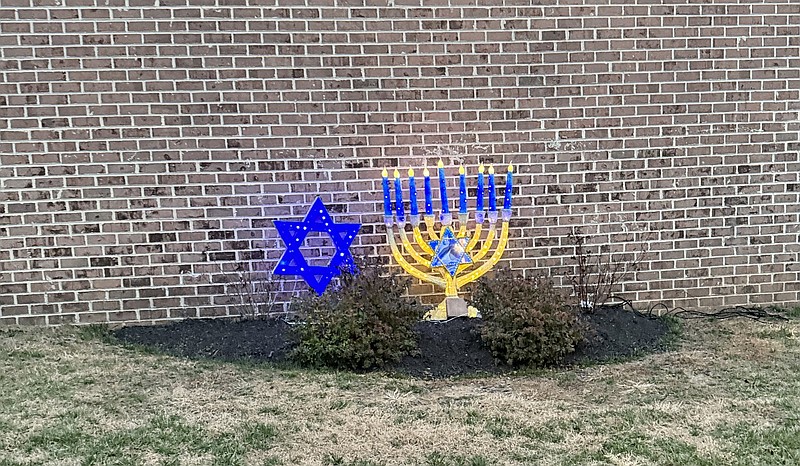
According to Jewish tradition, a small amount of oil miraculously lasted for eight days after the Temple was rededicated, enabling the sacred lamp there to remain lit until additional supplies were available. Because of this, Jews celebrate the holiday by lighting candles each night on a candelabrum known as a menorah. The idea is to bring light into the darkness of this time of year and to brighten a world that desperately needs it.
During Hanukkah, Jews express joy at their ancestors’ victory but make it clear that they understand the conflict itself was the result of the kind of persecution the Jewish people have endured for thousands of years and has undergone a resurgence in recent years.
A synagogue in Britain was attacked this year on Yom Kippur, the holiest day in Judaism. People who make their Jewish identity clear in public have been subjected to harassment and assault. People seeking to protest Israel’s treatment of Palestinians have descended on American synagogues, shouting slurs and blocking entry to events, whether they have any relation to Israel or not. Synagogues and other Jewish institutions have felt compelled to employ armed guards at services and other activities. It’s shocking that people at prayer have to worry about being attacked.
Pushing back on this sort of oppression requires vigilance on the part of Jews and their allies in the larger community. That means engaging in acts of friendship and refusing to tolerate hateful acts or statements on the part of others.
We call on all people, regardless of their stance on the situation in the Middle East, to express their views in a peaceful, respectful manner. No matter how strong one’s feelings are, there is no excuse for engaging in harassment, intimidation, or worse, of anyone based on their identity, ethnicity or point of view. It does nothing but create a toxic atmosphere, and it’s certainly not persuasive. More likely it will harden the opinions that the people targeted already hold.
It’s important to remember that Jews in America and elsewhere don’t represent the Israeli government, and within the Jewish community there are differences of opinion on that country’s policies. Yet Jews here and around the world have been forced to live in fear.
There is no sugarcoating the situation. Jews who for generations felt welcome and accepted in this country are in a state of alarm. Nevertheless, celebrations of Hanukkah go on, and rightly so.
Traditionally Jews place menorahs in their windows so the lights may be seen by passersby. Public menorah lightings are common as well. These practices remind us that Jews will not give in to fear or let others’ vitriol halt their celebration.
We encourage non-Jews to seek out public Hanukkah celebrations and make a point of participating. In the current environment of hostility toward Jews, staging these activities is an act of bravery and defiance. Support from friends in the community, always welcome, is particularly meaningful now.
We should all be free to practice our faith in peace. May the Hanukkah candles help to bring lasting light and enlightenment to a world that badly needs it.