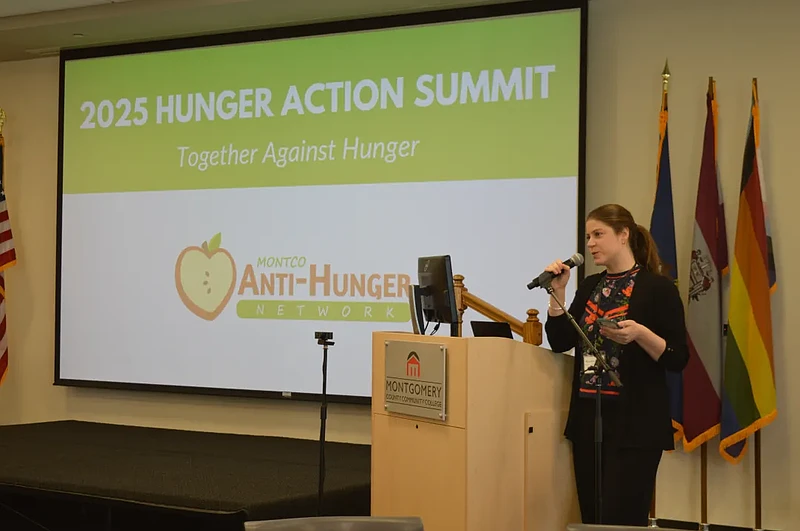
MontCo Anti-Hunger Network Executive Director Shannon Isaacs speaks during the 2025 Hunger Action Summit on Nov. 14, 2025 at Montgomery County Community College in Blue Bell. (Rachel Ravina – MediaNews Group).
Artificial intelligence technology is helping food pantry clients across Montgomery County get the assistance they need with more ease.
That was the goal for the MontCo Anti-Hunger Network in rolling out an initiative offering devices that provide translation technology for more than 120 languages, according to Executive Director Shannon Isaacs.
“It’s really exciting to be able to solve a long term food problem. MontCo Anti-Hunger Network’s been working on translation and supporting, improving translation capabilities for the last decade, and to make a big step is really exciting,” Isaacs said in a recent interview.
Isaacs said the concept for the artificial intelligence translators came about earlier this year through the nonprofit designating federal COVID-19 relief dollars to pursue projects focusing on innovation. While many proposals have come from food pantries themselves, Isaacs emphasized how “we just saw the opportunity” to procure the AI translators.
“I think it was also an idea that this time had come,” Isaacs said, underscoring that with the new technology, “I think people will be able to understand each other better.”
American Rescue Plan Act monies obtained from the Montgomery County Recovery Office covered the innovation funds. Isaacs noted around $2,000 was designated to purchase the devices through the organization’s “general operating support and some grant funding.”
Isaacs said they were tested at Bethel Community and Willow Grove Baptist churches in Pottstown and Willow Grove, respectively, and received positive feedback from food pantry clients to bridge the gap between languages.
“It’s a very serious barrier,” Isaacs said. “I think it makes it difficult to get access to those resources. I think filling out forms can be a challenge.”
The Ambler-based nonprofit has 73 organizations under its umbrella focusing on addressing major food insecurity concerns. Isaacs said nearly 50 devices, most of which have translation capabilities for around 144 languages, have been requested so far. Of those, 36 handheld and 12 earbud versions have been distributed.
“Our neighbors will be able to access more support services,” Isaacs said. “I think just the ability to communicate and connect will be really, really changed. [It’s] just really exciting.”
The project was just one to come out of the MontCo Anti-Hunger Network’s Innovation Lab.
Isaacs noted how the federal COVID-19 relief dollars provided a vehicle for a number of organizations to help “build Montgomery County better … after COVID as a stronger system than it was before, and these innovation prototypes were part of that idea.”
“Expanding MAHN’s support of inner-pantry food sharing was another piece of that, and I think what’s amazing is, I think we really succeeded,” Isaacs said. “We really took a piece of federal funding, and we built something that is sustainable, that is better than what was here before … MAHN [is] substantially stronger.”
There’s been $71,700 earmarked for 10 prototypes hoping to change the nonprofit landscape for the better. The allocated county funding allows “people to test promising ideas that can be scaled.”
The first iteration took place during the 2023-24 cycle. There were six new projects and “funding for three who scaled or continued projects” selected for the 2025 Innovation Prototype cycle, which amassed around $21,000 in available funds.
“I’m really excited to see what there is,” Isaacs said. “I think that the source of all of the solutions to social problems [originates from] being deeply tied to the people we serve and to our neighbors experiencing food insecurity.
“I’m just really excited for the brilliant ideas that will come out of that. Maybe there’ll be ideas to close gaps and respond to federal funding shortages,” she continued. “Maybe there will be ideas to create more culturally appropriate spaces. I think there’s going to be a real opportunity to change systems to make them smarter, and kinder and more responsive to the needs of our community and our neighbors.”